

The world of work is changing faster than at any time in human history.
Just a decade ago, careers such as AI Prompt Engineer, Drone Operator, Climate Data Analyst, Creator Economy Manager, and Metaverse Architect barely existed. Today, thousands of professionals are earning from these fields. By 2035, the transformation will be even more dramatic.
Artificial Intelligence, biotechnology, robotics, renewable energy, quantum computing, space exploration, and digital economies are not simply creating new industries—they are rewriting the definition of a career itself.
Many jobs that students currently prepare for may become heavily automated. At the same time, entirely new professions will emerge, creating opportunities for those who understand where the world is heading.
The challenge for today’s youth is not choosing a career for the next five years. The real challenge is choosing a career that remains relevant, valuable, and rewarding in 2035 and beyond.
This guide explores the careers that are expected to shape the future global workforce and offers insights into the skills students should begin developing today.
—
Why Career Planning for 2035 Matters
Most students make career decisions based on current trends.
They look at today’s popular professions such as software engineering, medicine, accounting, law, government jobs, or management. While many of these careers will continue to exist, the way they operate will change significantly.
Consider this:
A software engineer in 2035 may spend more time collaborating with AI systems than writing code manually.
A doctor may rely on predictive AI tools capable of detecting diseases years before symptoms appear.
Teachers may become learning experience designers instead of traditional classroom lecturers.
Farmers may use autonomous drones and AI-driven sensors to manage crops.
In short, technology will not merely support professionals; it will become their working partner.
Students who understand this shift early will have a substantial advantage in the global job market.
1. Artificial Intelligence Systems Architect
2. Human-AI Collaboration Specialist
3. Climate Change Adaptation Consultant
4. Renewable Energy Systems Engineer
5. Biotechnology and Genetic Enhancement Specialist
6. Space Industry Professional
—
1. Artificial Intelligence Systems Architect
Artificial Intelligence is expected to become as fundamental to society as electricity and the internet are today.
However, AI systems cannot function independently. Organizations will require experts who can design, monitor, integrate, and improve complex AI ecosystems. This responsibility will belong to Artificial Intelligence Systems Architects.
These professionals will develop large-scale AI infrastructures used in healthcare, education, manufacturing, finance, transportation, defense, and research.
Rather than creating simple chatbots, they will oversee intelligent systems capable of making decisions, analyzing massive datasets, predicting outcomes, and optimizing operations.
For example, a global hospital network may use interconnected AI systems to diagnose diseases, allocate resources, predict patient emergencies, and coordinate treatment plans across countries.
An AI Systems Architect would ensure these systems operate efficiently, ethically, and securely.
Required Skills:
Artificial Intelligence
Machine Learning
Data Science
Cloud Computing
Cybersecurity
Human-AI Interaction
Ethical AI Governance
By 2035, nearly every industry will use AI. Companies will require specialists who understand both technology and business strategy. This combination will make AI architects among the highest-paid professionals worldwide.
—
2. Human-AI Collaboration Specialist
One of the biggest misconceptions about the future is that AI will replace humans completely.
In reality, the most successful organizations will combine human creativity with machine intelligence.
This creates demand for Human-AI Collaboration Specialists.
Their role will be to design workflows where humans and AI work together effectively. They will identify which tasks should be handled by machines and which require human judgment, empathy, creativity, or ethical reasoning.
Imagine a global marketing company.
AI may analyze billions of customer interactions and generate advertising concepts. However, humans will still be responsible for understanding emotions, culture, social trends, and ethical considerations.
The Human-AI Collaboration Specialist will bridge these two worlds.
Key Responsibilities
Designing AI-assisted workplaces
Improving productivity through automation
Training employees to work with AI tools
Ensuring ethical AI implementation
Managing human-machine decision systems
Future Potential
As AI adoption accelerates worldwide, organizations will need professionals who can maximize the strengths of both humans and intelligent machines.
This role is likely to become common in multinational corporations, governments, universities, and healthcare institutions.
—
3. Climate Change Adaptation Consultant
Climate change is no longer a future problem.
Rising temperatures, extreme weather events, water shortages, coastal flooding, and biodiversity loss are already affecting economies around the globe.
By 2035, governments and corporations will invest trillions of dollars in climate adaptation strategies.
Climate Change Adaptation Consultants will help cities, industries, and communities prepare for environmental challenges.
Their work may include developing flood-resistant infrastructure, designing sustainable water systems, planning climate-resilient agriculture, and creating disaster preparedness programs.
For example, coastal cities vulnerable to sea-level rise will require experts capable of assessing risks and developing long-term survival strategies.
Required Knowledge
Environmental Science
Climate Modeling
Sustainability Planning
Public Policy
Geographic Information Systems (GIS)
Disaster Management
Why This Career Matters
Unlike many technology-driven professions, climate adaptation combines science, policy, engineering, economics, and social welfare.
It addresses one of humanity’s most urgent challenges and offers opportunities across every continent.
—
4. Renewable Energy Systems Engineer
The energy sector is undergoing a historic transformation.
Countries are shifting from fossil fuels toward solar, wind, hydrogen, geothermal, and advanced battery technologies.
This transition will require millions of skilled professionals.
Renewable Energy Systems Engineers will design, install, optimize, and maintain clean energy infrastructures.
Their responsibilities will extend beyond power generation. They will also develop smart grids, energy storage systems, and decentralized energy networks capable of supplying electricity efficiently to entire regions.
A future city may generate most of its power from rooftop solar systems, community batteries, and offshore wind farms connected through AI-powered energy networks.
Renewable Energy Engineers will make such systems possible.
Skills Required
Electrical Engineering
Energy Storage Technologies
Smart Grid Systems
Hydrogen Energy Technologies
Sustainable Design
Data Analytics
Career Outlook
Governments worldwide have announced ambitious carbon reduction goals. Achieving these targets will create one of the largest employment opportunities of the century.
—
5. Biotechnology and Genetic Enhancement Specialist
The next revolution after information technology may be biotechnology.
Scientists are already editing genes, developing personalized medicines, and creating treatments previously considered impossible.
By 2035, Biotechnology and Genetic Enhancement Specialists may help prevent hereditary diseases, improve agricultural productivity, and develop highly personalized healthcare solutions.
Instead of prescribing identical medicines to every patient, doctors may use genetic information to design treatments tailored to individual biological profiles.
This approach could dramatically improve healthcare outcomes.
Areas of Work
Genetic Engineering
Personalized Medicine
Gene Therapy
Agricultural Biotechnology
Bioinformatics
Synthetic Biology
Why It Will Expand
Advances in gene-editing technologies and biological computing are expected to create entirely new industries, generating demand for professionals who understand both biology and technology.
—
6. Space Industry Professional
The space economy is moving beyond government agencies.
Private companies are investing heavily in satellite networks, lunar missions, asteroid exploration, space tourism, and the development of extraterrestrial resources.
By 2035, the global space economy could support millions of jobs.
Future professionals may work as:
Space Habitat Designers
Orbital Logistics Managers
Space Resource Analysts
Satellite Network Engineers
Space Tourism Coordinators
Aerospace Data Scientists
The expansion of commercial space activities will create opportunities not only for engineers but also for lawyers, business managers, educators, healthcare professionals, and environmental scientists.
The Bigger Picture
Just as aviation created thousands of professions beyond pilots, the space industry will generate an entire ecosystem of careers that today’s students are only beginning to imagine.
—
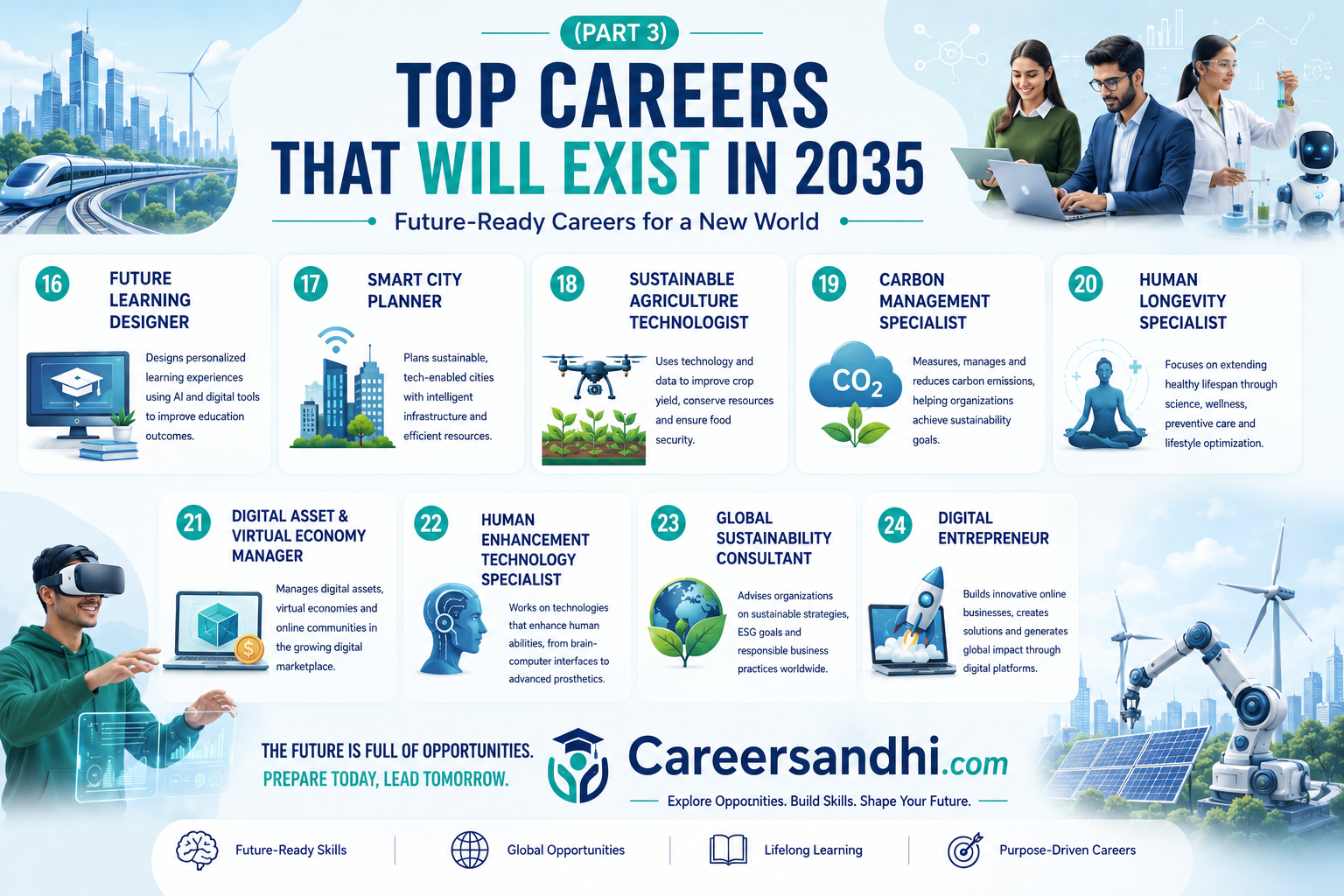
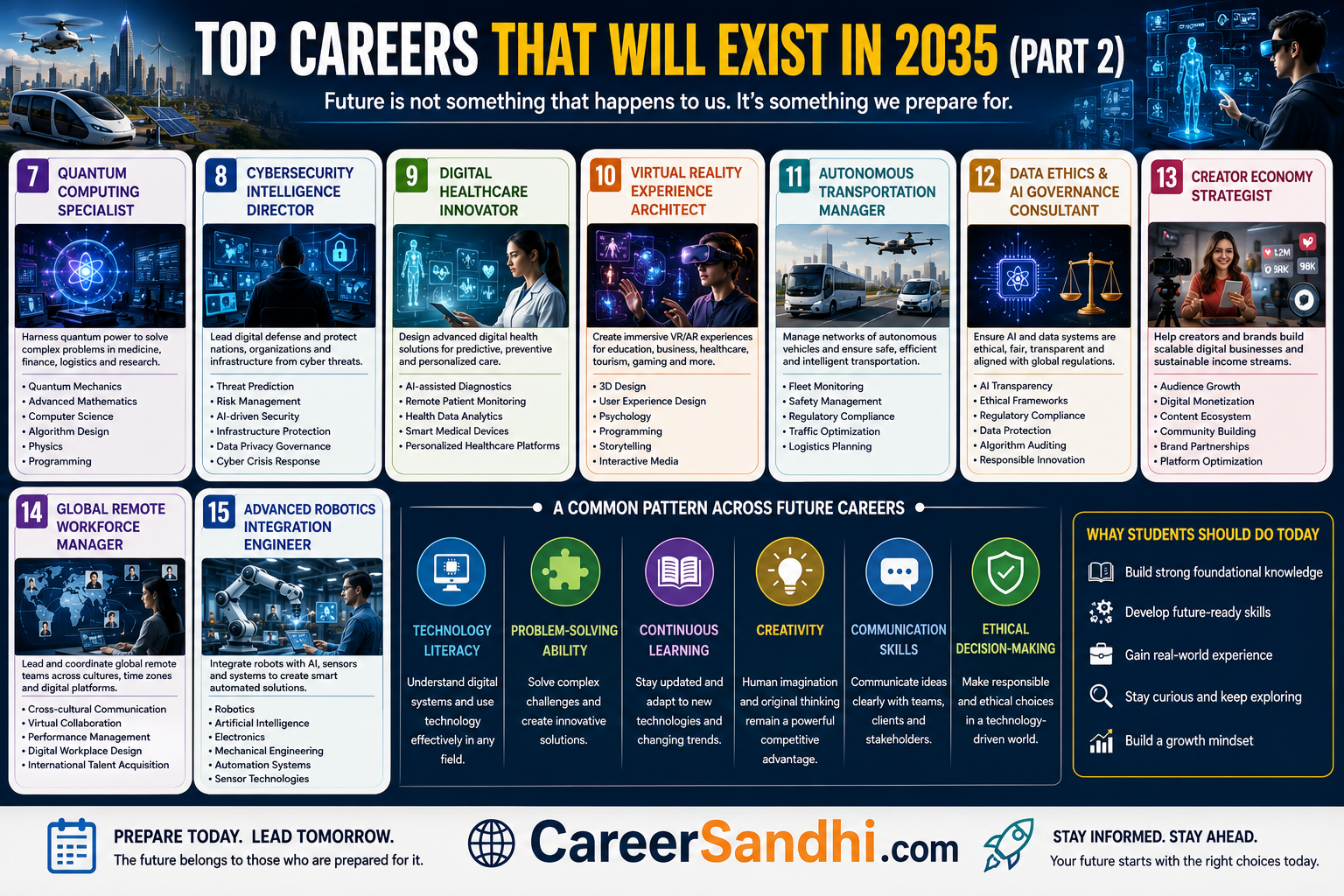
Part 2 will cover Quantum Computing Careers, Cybersecurity Leaders, Digital Health Experts, Virtual Reality Professions, Creator Economy Careers, Future Education Specialists, and several other high-growth professions expected to dominate the global workforce by 2035.


Leave a Reply