

- 1. AI Systems Architect
- 2. Generative AI Product Manager
- 3. AI Ethics and Governance Consultant
- 4. Autonomous Robotics Engineer
- 5. AI Healthcare Innovation Specialist
- Conclusion: The Future of AI Careers Belongs to Those Who Prepare Today
Introduction
Artificial Intelligence is no longer a futuristic concept reserved for science fiction. It has become the defining technology of the twenty-first century, transforming industries, governments, education systems, healthcare, finance, manufacturing, entertainment, and scientific research at an unprecedented pace. Over the last decade, AI has evolved from automating repetitive tasks to generating content, designing products, writing software, discovering medicines, and assisting complex decision-making.
By 2035, AI will not simply replace certain jobs—it will fundamentally redefine what work means. The World Economic Forum, leading universities, technology companies, and economic researchers consistently predict that millions of existing roles will evolve while entirely new professions emerge. History demonstrates this pattern repeatedly. The internet created careers that did not exist thirty years ago, such as digital marketing specialists, cloud architects, cybersecurity analysts, mobile app developers, and social media managers. Likewise, AI is creating an entirely new employment ecosystem.
For students, graduates, career changers, and professionals worldwide, this transition presents one of the greatest opportunities of our generation. Countries investing heavily in AI—including the United States, Canada, the United Kingdom, Germany, India, Singapore, Australia, Japan, South Korea, and the UAE are already experiencing growing demand for professionals capable of working alongside intelligent systems rather than competing against them.
The careers of 2035 will reward creativity, analytical thinking, interdisciplinary knowledge, ethical judgment, communication, leadership, and the ability to collaborate with advanced AI systems. Technical expertise will remain valuable, but equally important will be the capacity to solve real-world problems that machines alone cannot address. If you are planning your education today, choosing a university program, selecting certifications or simply exploring future career opportunities, understanding the emerging AI economy may become one of the most important investments in your future.
This article explores the most promising AI careers expected to dominate the global job market by 2035 and the skills required to thrive in them.
1. AI Systems Architect
One of the highest-paying and most influential careers by 2035 will be the AI Systems Architect. As organizations increasingly integrate AI into every department, they will require professionals capable of designing complete AI ecosystems rather than isolated applications. Unlike today’s software architects who primarily focus on databases, servers, and applications, AI Systems Architects will design intelligent infrastructures where multiple AI agents communicate seamlessly with cloud platforms, enterprise software, robotics, IoT devices, cybersecurity systems, and human employees.
For example, a multinational healthcare company may operate hundreds of AI models simultaneously. One model may diagnose diseases from medical images, another predicts hospital resource requirements, while another manages patient communication. An AI Systems Architect will ensure these systems function together securely, efficiently, and ethically. This career demands expertise in machine learning, cloud computing, distributed systems, cybersecurity, data engineering, software architecture, automation, and enterprise AI strategy. However, technical knowledge alone will not be sufficient. Architects will increasingly participate in executive decision-making because AI infrastructure will become central to organizational competitiveness.
Professionals entering this field should focus on Computer Science, Artificial Intelligence, Cloud Computing, Data Engineering, Software Engineering, and Enterprise Architecture while continuously updating their knowledge as AI technologies evolve.
2. Generative AI Product Manager
The explosion of Generative AI has already transformed how businesses create software, marketing campaigns, educational content, legal documents, financial reports, videos, music, and customer experiences. By 2035, virtually every major organization will employ specialists responsible for designing AI-powered products that solve practical problems.
A Generative AI Product Manager combines technical understanding with business strategy. Instead of building algorithms personally, they identify market opportunities, coordinate engineers, designers, researchers, legal teams, and executives, ensuring AI products deliver measurable value while complying with regulations.
Imagine an educational technology company developing personalized AI tutors capable of adapting to every student’s learning style. The Product Manager defines the product vision, evaluates customer needs, determines feature priorities, analyzes competitors, oversees ethical AI implementation, and measures product performance after launch.
Success in this profession requires understanding user behavior, business analytics, AI capabilities, prompt engineering, product lifecycle management, market research, UX design, leadership, and communication.
As AI products become increasingly integrated into everyday life, organizations will seek professionals who understand both human needs and technological possibilities.
3. AI Ethics and Governance Consultant
One of the fastest-growing career opportunities over the next decade will emerge from an area often overlooked by students: AI Ethics and Governance. Artificial Intelligence influences hiring decisions, loan approvals, insurance pricing, criminal justice systems, healthcare diagnoses, educational assessments, and national security. Such widespread influence inevitably raises concerns regarding fairness, accountability, transparency, privacy, bias, misinformation, and responsible innovation.
Governments across the world are already introducing AI regulations, while multinational companies are investing heavily in responsible AI frameworks. By 2035, organizations will require dedicated professionals responsible for ensuring AI systems comply with legal standards, ethical principles, and societal expectations.
An AI Ethics Consultant works closely with engineers, policymakers, legal experts, compliance officers, executives, and researchers. They evaluate algorithms for bias, recommend governance policies, conduct ethical impact assessments, design AI auditing frameworks, and help organizations balance innovation with public trust. Students interested in this profession should consider interdisciplinary education combining Artificial Intelligence, Law, Public Policy, Philosophy, Sociology, Psychology, Data Science, and Business Management. Individuals capable of connecting technology with human values will become indispensable as AI expands into increasingly sensitive sectors.
4. Autonomous Robotics Engineer
The robotics revolution expected over the next decade extends far beyond manufacturing. By 2035, autonomous robots will assist in agriculture, logistics, healthcare, elderly care, disaster response, construction, hospitality, mining, underwater exploration, and even space missions.
Autonomous Robotics Engineers will design machines capable of perceiving their environment, making decisions, learning from experience, and collaborating safely with humans.
For instance, hospitals may deploy robotic assistants transporting medicines, disinfecting operating rooms, monitoring patient recovery, and assisting surgeons during complex procedures. Agricultural robots may independently analyze soil quality, detect crop diseases, optimize irrigation, and harvest produce with remarkable precision.
Developing these intelligent machines requires expertise in computer vision, reinforcement learning, embedded systems, mechanical engineering, sensors, AI programming, robotics operating systems, digital twins, and human-machine interaction. As global labour shortages increase and automation expands into physically demanding industries, Autonomous Robotics Engineers will become critical contributors to economic productivity.
5. AI Healthcare Innovation Specialist
Healthcare is expected to experience one of the most profound AI transformations by 2035. Rather than replacing doctors, AI will enhance diagnosis, treatment planning, drug discovery, personalized medicine, genomic analysis, hospital management, remote monitoring, and preventive healthcare.
This evolution creates demand for AI Healthcare Innovation Specialists—professionals capable of bridging medicine and advanced artificial intelligence.
Their responsibilities may include implementing AI diagnostic systems, evaluating predictive healthcare algorithms, managing digital health platforms, integrating wearable health technologies, coordinating clinical AI research, and ensuring patient safety throughout technological adoption.
Unlike traditional healthcare careers focused exclusively on clinical practice, this profession combines medical knowledge with machine learning, healthcare analytics, health informatics, regulatory compliance, biomedical engineering, and digital transformation.
Students pursuing medicine, biotechnology, biomedical engineering, nursing, pharmacy, computer science, or health informatics can position themselves advantageously by developing AI literacy alongside their primary specialization.
As aging populations continue to grow worldwide, healthcare innovation driven by AI will become one of the largest employment sectors of the future.
Why These Careers Matter More Than Traditional Job Titles
One noticeable trend across all emerging AI professions is that employers increasingly value interdisciplinary expertise over narrow specialization. The future workforce will consist of professionals capable of combining technological knowledge with business strategy, human psychology, ethics, communication, creativity, design thinking, and leadership.
The most successful professionals in 2035 may not necessarily be those who know the most programming languages. Instead, they will be individuals capable of asking better questions, solving complex societal challenges, leading multidisciplinary teams, interpreting AI-generated insights, and creating meaningful human value.
Education is therefore shifting away from memorization toward adaptability, lifelong learning, critical thinking, and collaborative intelligence. Students who embrace this mindset today will be significantly better prepared for tomorrow’s rapidly evolving employment landscape.
In Part 2, we will cover the next high-growth careers such as AI Cybersecurity Specialist, AI Prompt Engineer 2.0, AI Education Designer, AI Digital Twin Engineer, AI Sustainability Analyst, Human-AI Collaboration Manager, Quantum AI Research Scientist and AI Entrepreneurship, followed by salary trends, future skills, degrees, certifications.
Conclusion: The Future of AI Careers Belongs to Those Who Prepare Today
The AI revolution is no longer a prediction—it is shaping the global workforce today. By 2035, the world’s most valuable professionals will not simply be those who understand artificial intelligence, but those who know how to work alongside it to solve complex human challenges. From AI Systems Architects and Autonomous Robotics Engineers to AI Healthcare Innovation Specialists, AI Ethics Consultants, and Human-AI Collaboration Managers, the careers of tomorrow will demand a powerful combination of technical expertise, creativity, critical thinking, leadership, and lifelong learning.
For students, graduates, and working professionals across the world, this is the ideal time to invest in future-ready skills. Learning Artificial Intelligence, Machine Learning, Data Science, Generative AI, Prompt Engineering, Cloud Computing, Cybersecurity, Robotics, Automation, Business Analytics, and AI Ethics can significantly improve career opportunities in the coming decade. At the same time, developing soft skills such as communication, problem-solving, adaptability, emotional intelligence, and innovation will become equally important as AI takes over routine tasks.
The good news is that you do not need to become an AI researcher to succeed in the AI-driven economy. Every industry—including healthcare, education, finance, agriculture, manufacturing, law, marketing, entertainment, logistics, and environmental sustainability—is creating new roles where professionals who understand AI will have a competitive advantage. Whether your background is engineering, medicine, business, design, or the humanities, AI literacy will become one of the most valuable career assets of the future.
The next decade will reward those who embrace continuous learning instead of fearing technological change. Universities are introducing AI-focused degree programs, global companies are investing billions in AI innovation, and governments are actively supporting digital transformation. This means the demand for skilled AI professionals is expected to grow across North America, Europe, Asia, the Middle East, Africa, and emerging digital economies, creating exciting opportunities for talent worldwide.
The question is no longer whether AI will change the job market—it is already changing. The real question is whether you will be prepared to lead that change. Start building your AI skills today. Stay curious, earn relevant certifications, work on real-world projects, and continue learning as technology evolves. Those who prepare now will not just secure high-paying jobs in 2035 they will help shape the future of work itself.
Also Read
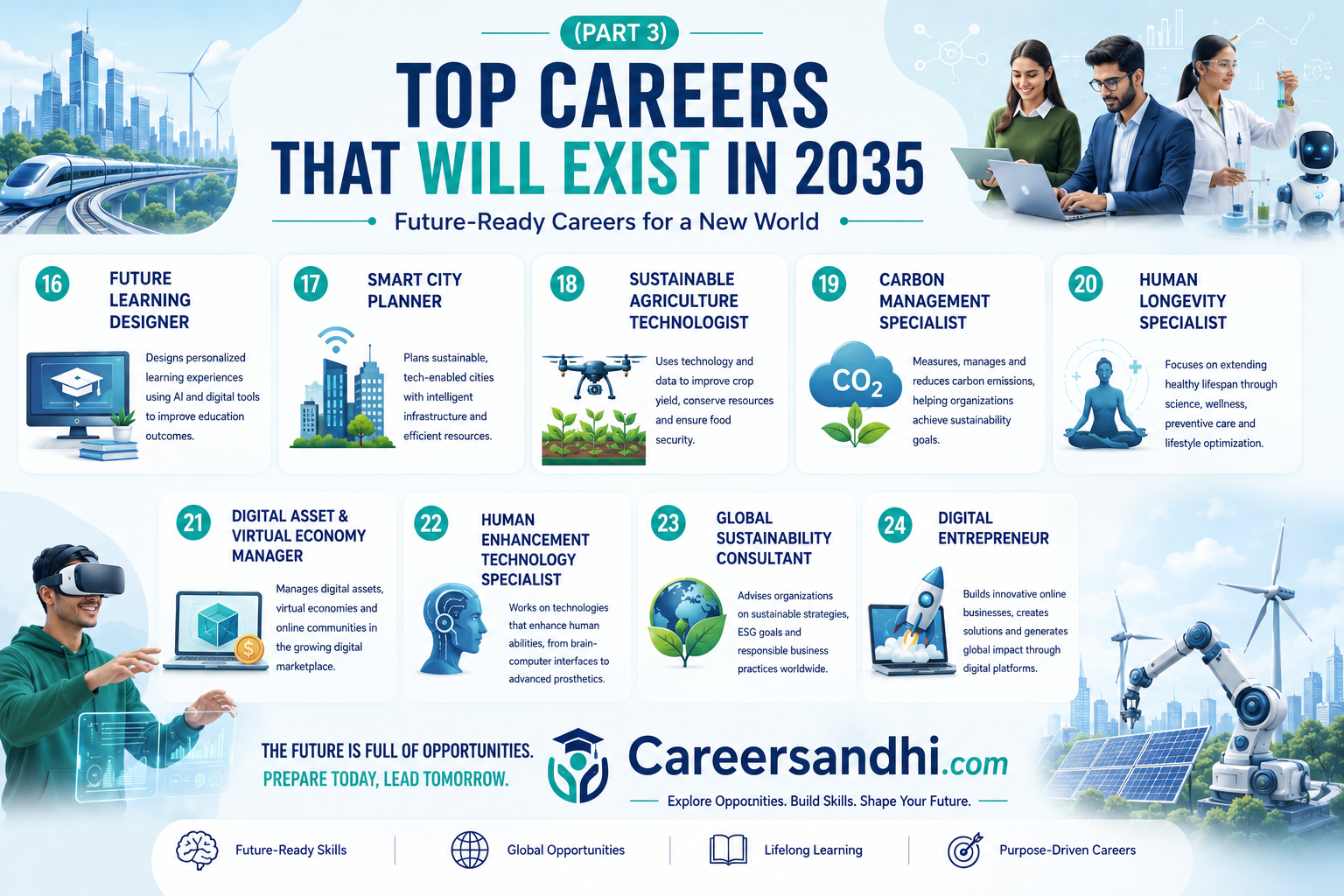
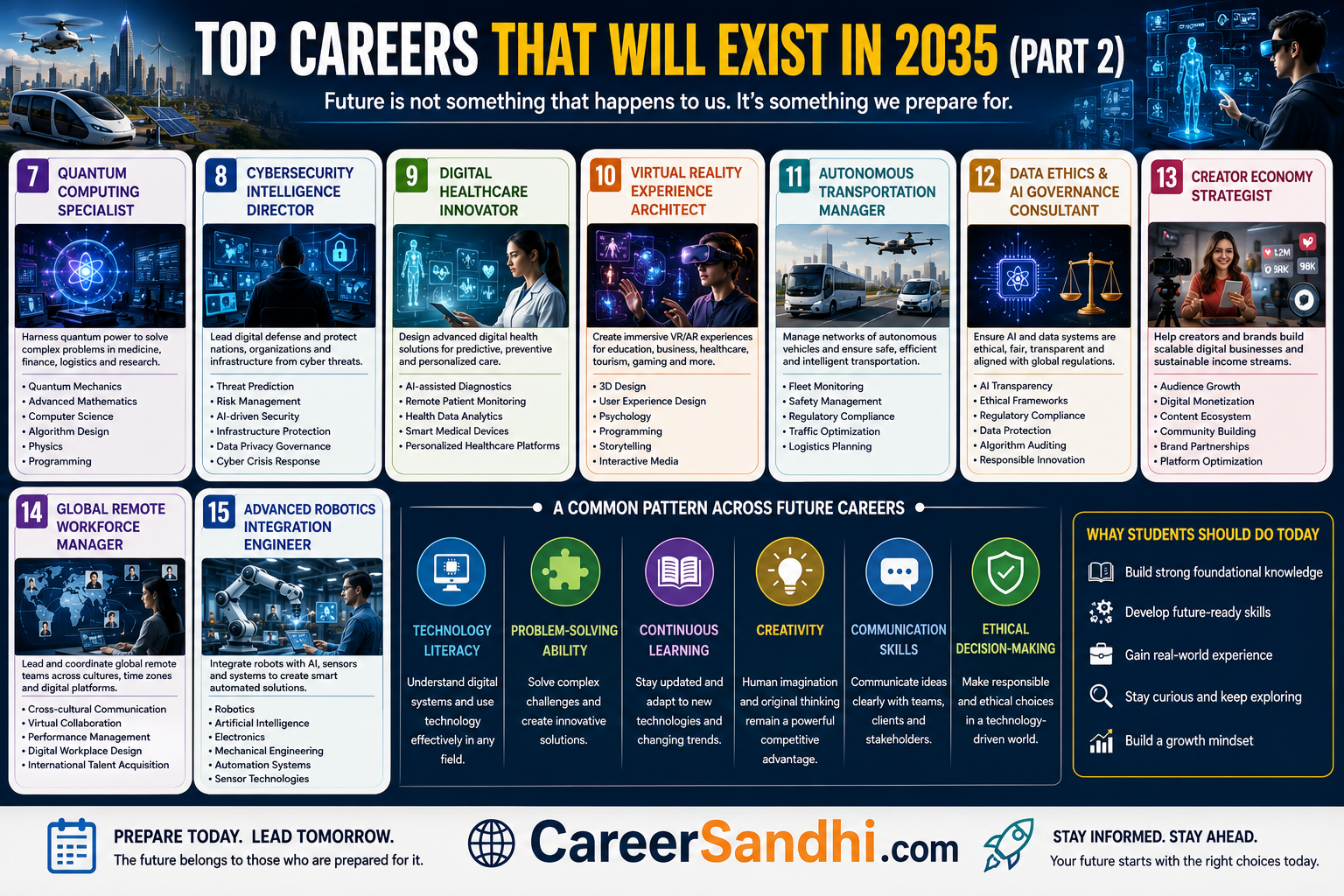
Top Careers That Will Exist in 2035: A Complete Guide for Future-Ready Students (Part-I) 1-6
keywords
- Best AI careers in 2035
- Highest-paying AI jobs
- Future AI jobs for students
- AI jobs without coding
- AI careers after Computer Science
- Best AI certifications
- AI skills for the future
- AI careers after engineering
- AI jobs in healthcare
- AI jobs in cybersecurity
- Will AI replace programmers?
- How to become an AI Engineer
- Artificial Intelligence career roadmap
- AI jobs for freshers
- AI jobs after graduation
Leave a Reply