
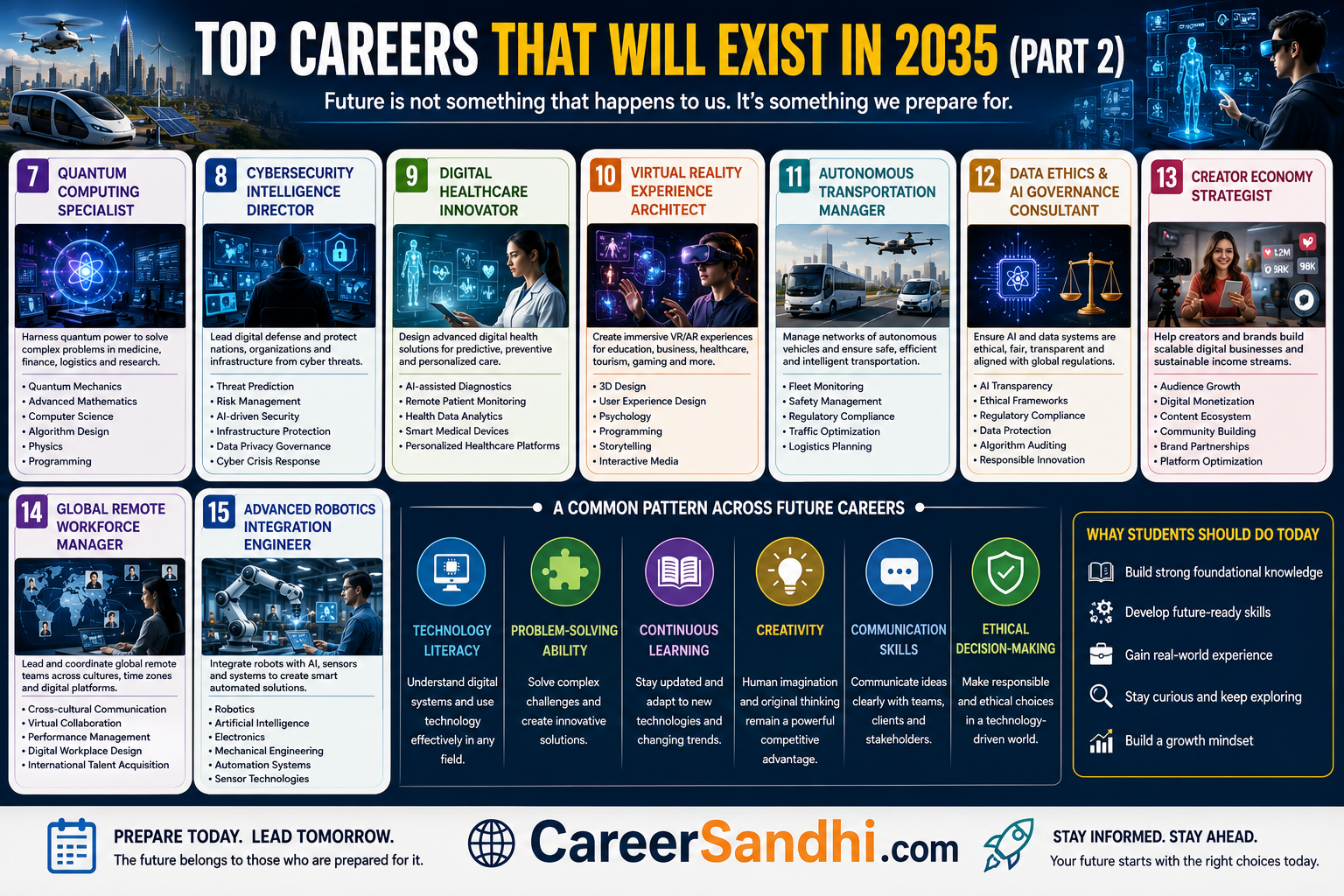
In the first part of this guide, we explored careers emerging from artificial intelligence, climate science, biotechnology, renewable energy, and the space economy. However, these sectors represent only a portion of the opportunities that will shape the next decade. The world of 2035 will be more connected, more digital, and more data-driven than any previous era. Entire industries will depend on technologies that are still developing today. Students who prepare early for these changes will position themselves ahead of millions of competitors in the global workforce. Let us continue exploring the professions that are likely to dominate the future.
7. Quantum Computing Specialist
For decades, classical computers have powered modern civilization. Yet some problems remain too complex even for the most advanced supercomputers. Quantum computing aims to solve this limitation. Unlike traditional computers that process information using bits (0s and 1s), quantum computers use quantum bits or qubits, enabling them to perform calculations at unprecedented speeds.
By 2035, organizations involved in drug discovery, financial modeling, cybersecurity, logistics, and advanced scientific research may rely heavily on quantum systems. Quantum Computing Specialists will develop algorithms, optimize quantum hardware, and create practical applications for industries.
For example, pharmaceutical companies may use quantum computers to simulate molecular interactions in minutes rather than years, accelerating the discovery of life-saving medicines.
Key Skills
- Quantum Mechanics
- Advanced Mathematics
- Computer Science
- Algorithm Design
- Physics
- Programming
Career Potential
Although quantum computing is still in its early stages, experts believe it could become one of the most valuable technological fields of the twenty-first century.
8. Cybersecurity Intelligence Director
As technology advances, cyber threats become more sophisticated. The future will involve billions of connected devices, smart cities, autonomous vehicles, intelligent factories, and digital financial systems. Every connected system becomes a potential target for cyber-attacks.
Consequently, cybersecurity will evolve from an IT function into a strategic leadership discipline.
Cybersecurity Intelligence Directors will oversee national, corporate, and institutional digital defence systems. Their responsibilities will include:
- Threat prediction
- Digital risk management
- AI-driven security systems
- Critical infrastructure protection
- Data privacy governance
- Cyber crisis response
Imagine a future where an attack on a city’s smart grid could disrupt transportation, healthcare, and communication simultaneously. Cyber security leaders will be responsible for preventing such scenarios.
Why Demand Will Surge
As digital assets become more valuable than physical assets in many sectors, organisations will invest heavily in cybersecurity. Security professionals are expected to remain among the most sought-after experts worldwide.
9. Digital Healthcare Innovator
Healthcare is entering a transformative era. The traditional model of visiting a hospital only after becoming ill is gradually shifting toward preventive and predictive healthcare.
By 2035, wearable sensors, AI diagnostics, remote monitoring devices, and digital health platforms may continuously track individual health conditions.
Digital Healthcare Innovators will design and manage these systems. Their work may involve:
- AI-assisted diagnostics
- Remote patient monitoring
- Health data analytics
- Smart medical devices
- Personalized healthcare platforms
Consider a wearable device capable of identifying early signs of heart disease years before symptoms appear. Such technologies could dramatically reduce healthcare costs while improving quality of life.
Educational Background
Professionals may come from medicine, engineering, biotechnology, computer science, or healthcare management.
Future Outlook
Aging populations and increasing healthcare demands make this one of the most stable and impactful future career paths.
10. Virtual Reality Experience Architect
The internet transformed how people access information. Virtual and augmented reality may transform how people experience information.
By 2035, immersive digital environments may become common in education, healthcare, business meetings, tourism, retail, and entertainment. Virtual Reality Experience Architects will create these environments. Unlike traditional software developers, they will focus on designing realistic, engaging, and psychologically effective digital experiences. Examples include:
- Virtual classrooms
- Medical simulation training
- Digital tourism experiences
- Corporate collaboration spaces
- Immersive gaming environments
A student in Africa may attend a virtual engineering laboratory hosted by a university in Europe without leaving home. The professionals creating these experiences will be in high demand.
Skills Required
- 3D Design
- User Experience Design
- Psychology
- Programming
- Storytelling
- Interactive Media
11. Autonomous Transportation Manager
Transportation is moving toward automation.
Self-driving cars, autonomous trucks, delivery drones, robotic ships, and intelligent public transportation systems are expected to become increasingly common by 2035.
However, these systems require human oversight. Autonomous Transportation Managers will coordinate large networks of automated vehicles. Their responsibilities may include:
- Fleet monitoring
- Safety management
- Regulatory compliance
- Traffic optimization
- Logistics planning
For instance, a logistics company operating thousands of autonomous delivery vehicles will need specialists capable of managing performance, safety, and operational efficiency.
Why This Career Matters The transportation industry is one of the world’s largest employers. Automation will change job roles rather than eliminate the need for human expertise entirely.
12. Data Ethics and AI Governance Consultant
Artificial intelligence raises important ethical questions. Who is responsible when an AI system makes a mistake?
How should organizations handle personal data?
How can society ensure algorithms remain fair and unbiased?
These questions will become increasingly important as AI influences hiring decisions, healthcare recommendations, financial approvals, and public services.
Data Ethics and AI Governance Consultants will help organizations navigate these challenges. Their work combines technology, law, ethics, policy, and risk management.
Areas of Responsibility
- AI transparency
- Ethical decision frameworks
- Regulatory compliance
- Data protection
- Algorithm auditing
- Responsible innovation
Future Significance
Governments around the world are already developing AI regulations. As these regulations expand, demand for governance specialists will increase significantly.
13. Creator Economy Strategist
The creator economy has grown from a niche activity into a global industry. Millions of individuals now earn income through digital content, online education, podcasts, newsletters, video production, and personal brands. By 2035, this sector may rival traditional media industries. Creator Economy Strategists will help creators, educators, influencers, and businesses build sustainable digital enterprises. Their responsibilities include:
- Audience growth strategy
- Digital monetization
- Content ecosystem development
- Community building
- Brand partnerships
- Platform optimization
Unlike traditional marketing professionals, these specialists will focus on helping individuals transform expertise into scalable businesses.
Why It Matters
Knowledge itself is becoming a valuable digital asset. People who can package expertise effectively will create entirely new economic opportunities.
14. Global Remote Workforce Manager
Remote work is no longer an experiment. Companies increasingly recruit talent regardless of geographic location. By 2035, many organizations may operate with employees distributed across dozens of countries. Global Remote Workforce Managers will coordinate these international teams. Their work includes:
- Cross-cultural communication
- Virtual collaboration systems
- Performance management
- Digital workplace design
- International talent acquisition
Managing a workforce spread across multiple time zones requires specialized leadership skills that traditional management programs often overlook.
Career Growth As global hiring becomes standard practice, organizations will need professionals capable of creating productive and inclusive remote workplaces.
15. Advanced Robotics Integration Engineer
Robots are becoming more intelligent, affordable, and versatile. By 2035, robotic systems may assist in manufacturing, healthcare, agriculture, construction, logistics, and disaster response. Advanced Robotics Integration Engineers will connect robots with AI systems, sensors, data networks, and operational workflows. Their goal is not merely to build robots but to ensure robots work effectively within real-world environments. For example, hospitals may use robotic assistants for patient transport, medication delivery, and sanitation tasks. Integration engineers will ensure these systems function safely and efficiently.
Core Competencies
- Robotics
- Artificial Intelligence
- Electronics
- Mechanical Engineering
- Automation Systems
- Sensor Technologies
Future Potential
As labor shortages emerge in many countries, robotic solutions are expected to become increasingly important.
A Common Pattern Across Future Careers
Although these professions appear different, they share several characteristics. The careers most likely to thrive in 2035 involve:
Technology Literacy Future professionals must understand digital systems regardless of their primary field.
Problem-Solving Ability Employers increasingly value individuals who can solve complex challenges rather than simply perform repetitive tasks.
Continuous Learning The future workforce will require constant adaptation as technologies evolve.
Creativity Machines can automate processes, but human imagination remains a critical advantage.
Communication Skills Even highly technical professionals must explain ideas clearly to colleagues, clients, and stakeholders.
Ethical Decision-Making As technology gains influence, ethical judgment becomes increasingly important.
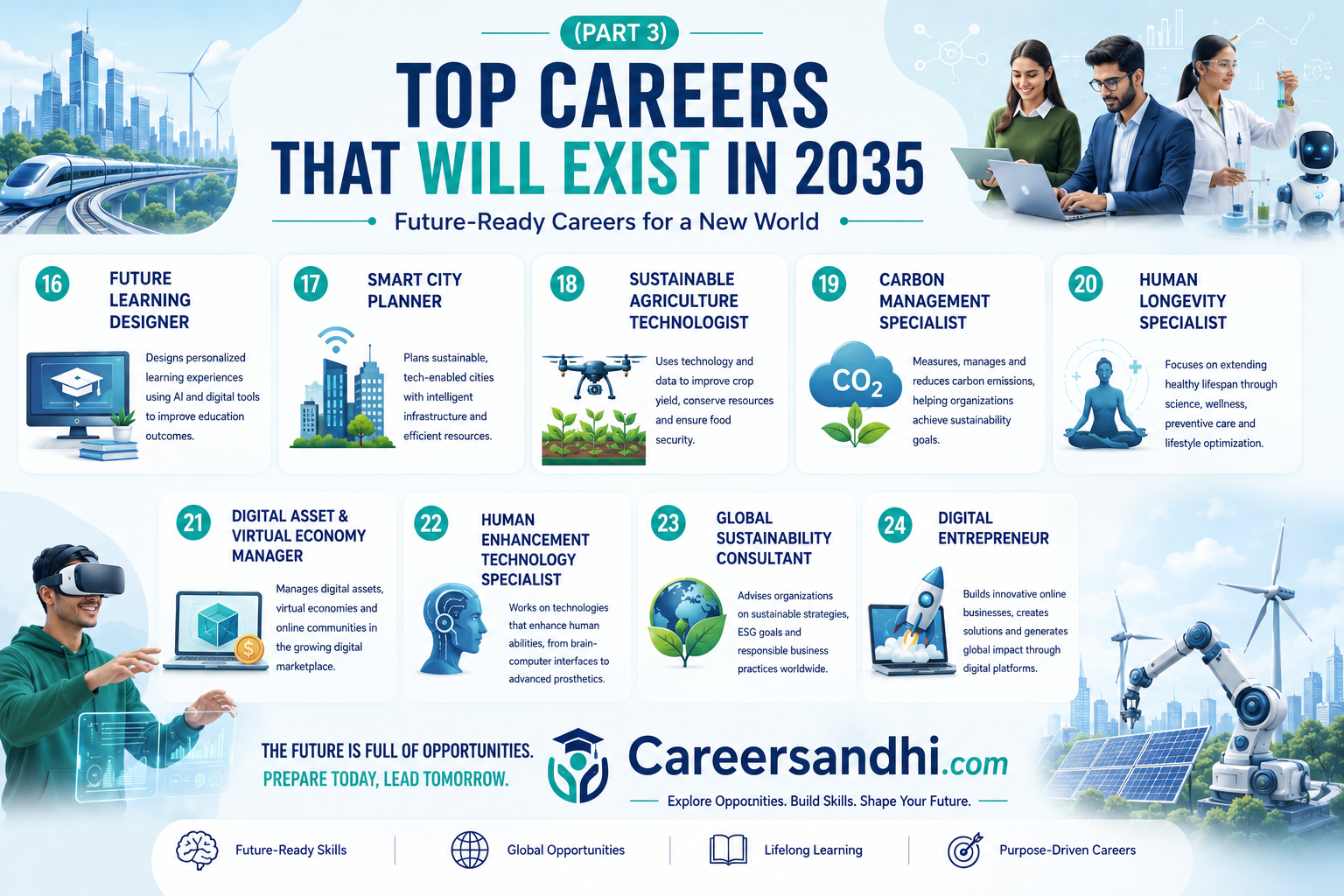
In Part 3, we will explore future careers in education, sustainability, agriculture, smart cities, finance, human enhancement technologies, digital entrepreneurship, and conclude with a roadmap showing how today’s students can prepare themselves to succeed in the job market of 2035.
Read Part 3

Leave a Reply