
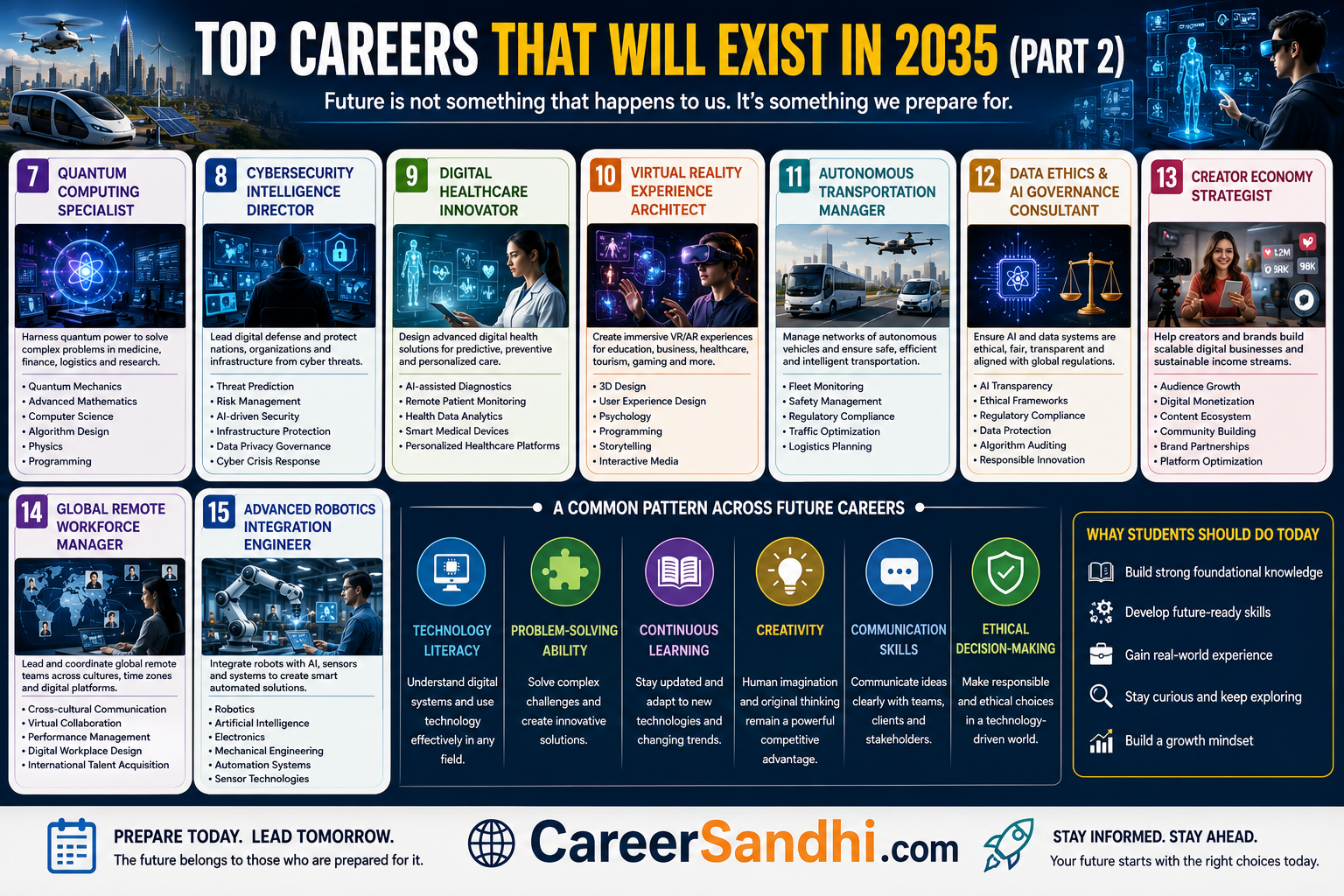
Part 1 Part 2
As we move deeper into the twenty-first century, one reality becomes increasingly clear: the future job market will reward adaptability more than specialization alone.
Previous generations often chose one profession and remained in that field for decades. The workforce of 2035 will look very different. Professionals may work across multiple industries, combine technical and creative skills, and continuously reinvent themselves as technology evolves.
The careers discussed in this final section are not simply future jobs. They represent some of the most significant opportunities emerging from global challenges such as population growth, urbanization, sustainability, education reform, food security, and human development.
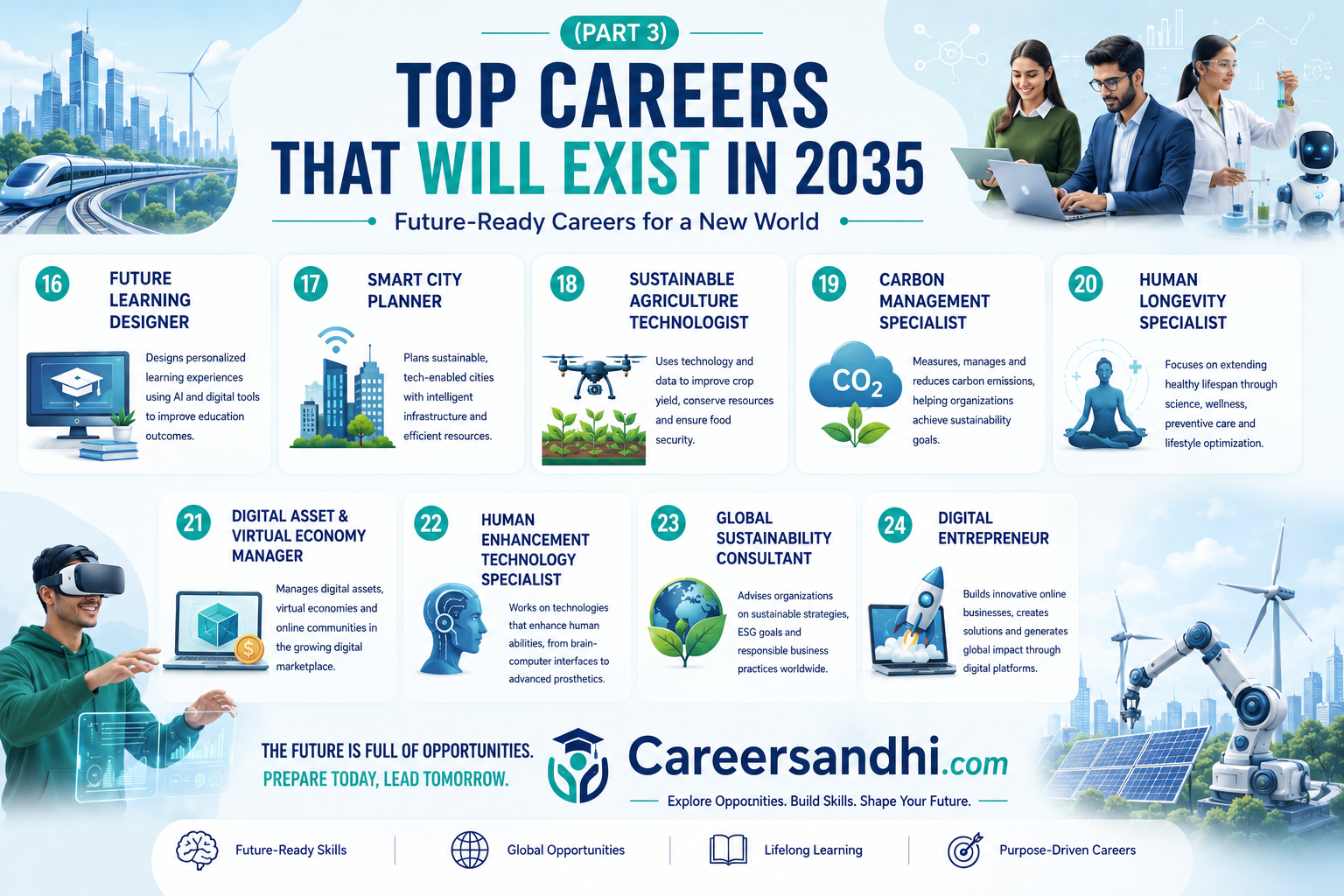
16. Future Learning Designer
Education itself is undergoing a transformation.
For centuries, learning followed a relatively fixed model: teachers delivered information, students memorized it, and examinations measured retention. By 2035, learning is expected to become far more personalized.
Artificial intelligence will adapt educational content according to a student’s strengths, weaknesses, learning speed, interests, and career goals. Future Learning Designers will create these intelligent educational ecosystems.
Rather than teaching a classroom of students the same lesson, they will design customized learning journeys capable of helping each learner achieve maximum potential.
Imagine a student interested in aerospace engineering. An AI-powered learning platform may automatically recommend mathematics modules, physics simulations, coding exercises, virtual laboratory experiences, and industry projects tailored specifically to that student’s ambitions.
Future Learning Designers will build these systems.
Required Skills
- Educational Technology
- Learning Psychology
- Curriculum Development
- Artificial Intelligence Applications
- User Experience Design
- Data Analytics
Career Outlook
Education is one of humanity’s largest industries. As digital learning expands globally, professionals capable of designing effective learning experiences will become increasingly valuable.
17. Smart City Planner
By 2035, more than two-thirds of the global population may live in urban areas. Managing these rapidly growing cities will require innovative solutions.
Future cities will use connected sensors, AI-driven infrastructure, intelligent transportation networks, automated utilities, and real-time environmental monitoring. Smart City Planners will coordinate these complex systems. Their responsibilities may include:
- Urban mobility planning
- Sustainable infrastructure design
- Energy optimization
- Waste management systems
- Public safety technologies
- Digital governance frameworks
For example, a smart city may automatically adjust traffic signals based on real-time traffic conditions, reducing congestion and pollution simultaneously. The professionals designing such systems will shape the future of urban living.
Why This Career Matters
Urbanization is one of the defining trends of the century. Cities that function efficiently will attract investment, talent, and economic growth.
18. Sustainable Agriculture Technologist
Feeding a growing global population remains one of humanity’s greatest challenges. Climate change, water scarcity, shrinking agricultural land, and increasing food demand require innovative solutions.
The farms of 2035 may look very different from traditional farms. Autonomous tractors, AI-powered crop monitoring systems, precision irrigation technologies, agricultural drones, and biotechnology-based crop improvements are expected to become common.
Sustainable Agriculture Technologists will help farmers maximize productivity while minimizing environmental impact.
Areas of Work
- Precision Farming
- Agricultural Robotics
- Vertical Farming
- Hydroponics
- Soil Health Analytics
- Climate-Resilient Agriculture
Global Importance
Food security affects every nation. Professionals who can improve agricultural efficiency while preserving natural resources will be highly valued worldwide.
19. Carbon Management Specialist
Governments and corporations have announced ambitious targets to reduce greenhouse gas emissions.
Achieving these goals requires professionals capable of measuring, monitoring, and reducing carbon footprints.
Carbon Management Specialists will become key players in sustainability initiatives.
Their work may involve:
- Carbon accounting
- Emissions auditing
- Sustainability reporting
- Carbon offset projects
- Environmental compliance
- Renewable energy integration
Large organizations will increasingly require experts who can help them meet environmental regulations and sustainability commitments.
Future Demand
As climate policies become stricter, carbon management is expected to evolve into a major global profession.
20. Human Longevity Specialist
People are living longer than ever before. At the same time, advances in medicine, biotechnology, nutrition, genetics, and preventive healthcare are creating opportunities to improve both lifespan and quality of life.
Human Longevity Specialists will focus on extending healthy living rather than simply treating diseases. Their work may combine:
- Personalized health programs
- Genetic analysis
- Nutrition science
- Preventive medicine
- Lifestyle optimization
- Aging research
Future healthcare systems may focus less on treating illness and more on preventing it entirely.
Why This Career Is Growing
An aging global population creates increasing demand for professionals who can help individuals remain healthy, productive, and independent throughout their lives.
21. Digital Asset and Virtual Economy Manager
The economy of 2035 may include substantial activity within digital environments. Virtual goods, digital identities, online intellectual property, and decentralized financial systems are likely to play increasingly important roles. Digital Asset Managers will oversee these emerging forms of value. Their responsibilities may include:
- Managing digital intellectual property
- Virtual business operations
- Online economic ecosystems
- Blockchain-based assets
- Digital ownership systems
As younger generations spend more time in digital environments, virtual economies may become a significant source of employment and wealth creation.
22. Human Enhancement Technology Specialist
Technological advances are beginning to blur the boundary between biology and technology. Researchers are developing:
- Brain-computer interfaces
- Advanced prosthetics
- Neural implants
- Cognitive enhancement tools
- Assistive technologies
Human Enhancement Technology Specialists will help develop, implement, and regulate these innovations.
Their work could transform the lives of individuals with disabilities while opening entirely new possibilities for human performance.
Ethical Considerations
Because these technologies directly affect human capabilities, ethical and regulatory expertise will become equally important.
23. Global Sustainability Consultant
Sustainability is becoming a strategic priority for governments, corporations, educational institutions, and international organizations.
Future Sustainability Consultants will help organizations balance economic growth with environmental responsibility. Their work will involve:
- Sustainable business strategy
- Resource management
- Circular economy planning
- Environmental impact assessment
- ESG implementation
- Sustainable innovation
Rather than being limited to environmental science, this profession combines economics, technology, business, and policy.
Why It Will Thrive
Consumers, investors, and governments increasingly expect organizations to demonstrate environmental responsibility.
24. Digital Entrepreneur
One of the most powerful career opportunities of 2035 may not be a traditional job at all. Technology has dramatically reduced the barriers to entrepreneurship.
Today, a single individual can build an audience, create products, provide services, and generate revenue globally using digital platforms.
By 2035, digital entrepreneurship is likely to become even more accessible. Future entrepreneurs may launch businesses involving:
- AI-powered services
- Online education
- Digital consulting
- Content creation
- Virtual products
- Specialized communities
- Global marketplaces
Unlike previous generations, young people will not necessarily need large amounts of capital to build successful businesses.
Knowledge, creativity, and digital skills may become their most valuable assets.
The Skills That Will Matter More Than Any Degree
One important lesson emerges from studying future careers:
Specific job titles may change, but certain skills will remain valuable across every industry.
Critical Thinking
Future employers will value people who can analyze information, evaluate options, and make sound decisions.
Adaptability
Technology changes rapidly. Professionals must continuously learn and evolve.
Communication
Ideas only create value when they can be communicated effectively.
Creativity
Innovation remains one of the few capabilities that cannot be easily automated.
Digital Literacy
Regardless of profession, understanding technology will become essential.
Emotional Intelligence
Leadership, teamwork, empathy, negotiation, and relationship-building will continue to be uniquely human strengths.
Lifelong Learning
The most successful professionals of 2035 may not be those with the highest IQs but those who learn fastest.
Final Thoughts: The Future Belongs to the Prepared
Every generation faces uncertainty about the future.
However, today’s students possess something previous generations never had: access to unlimited knowledge, global learning opportunities, and powerful digital tools.
The careers discussed in this article may evolve over time. Some job titles will change. New industries will emerge. Others may disappear.
Yet the underlying trend is unmistakable.
The future will reward individuals who embrace technology, solve meaningful problems, think globally, communicate effectively, and remain committed to continuous learning.
The students who begin preparing today will not simply adapt to the world of 2035—they will help create it.
The question is no longer, “What job should I choose?”
The more important question is:
“What skills should I develop today to remain valuable in a world that is constantly changing?” Read Part 1 and Part 2
Those who answer that question wisely will discover that the future offers far more opportunities than challenges.

Leave a Reply